" href="https://www.crgeng.com/the-deadliest-fall/" rel="bookmark">
The Deadliest Fall

18 December 2004

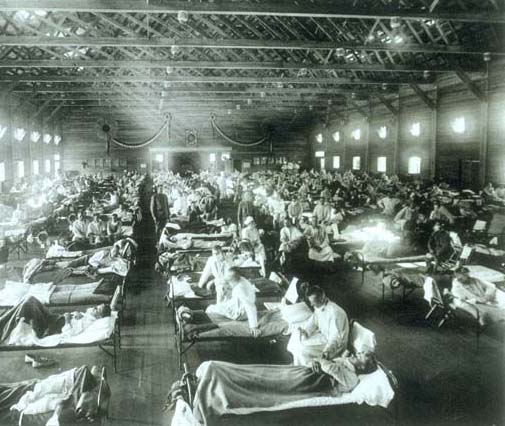
Emergency hospital during 1918 influenza epidemic, Camp Funston, Kansas (source: National Museum of Health and Medicine, AFIP).

A bout of the flu can be mild. In young, healthy adults, many infections pass unnoticed. But sometimes the influenza virus evolves into a strain that decimates its victims. The worst known strain swept the world in the Fall of 1918, infecting 500-1000 million and killing 40-100 million, about 2-5% of people.

There are several theories about where the pandemic began, but the likeliest origin was in Haskell County, Kansas, in the United States. People in the sparsely populated county, where farmers raised pigs, poultry, cattle, and grain, began suffering from influenza in late January 1918. Unusually for flu, it was young, healthy adults who were hardest hit. Victims fell ill suddenly, many progressing to pneumonia and dying, often within days. Within weeks, however, the epidemic ended. The natural geographic isolation of this community normally might have contained the fatal flu in a sort of unintentional quarantine, but the First World War intervened. Men were uprooted from their home towns and congregated in huge numbers in army camps for training and then shipping out to other camps or to fight in Europe. The destination for men from Haskell County was Camp Funston, part of Fort Riley, Kansas, where the first influenza case was reported in early March. As soldiers moved among camps, the virus spread. Within two months, the epidemic spread to most of the army camps and most of the largest cities in the United States. As American soldiers went to France, so did the virus, spreading first from the port of Brest.

The flu then spread worldwide. The pandemic reached its height in the Fall of 1918. Spain was affected early, and because Spain was not fighting in the World War, there was no wartime censorship, and news of the outbreak became widely known, leading to the flu being called the Spanish Flu in many countries. In Spain, however, it was called French Flu or the Naples Soldier. In India, about 12 million people died of flu. In some US cities, people died so quickly that morticians couldn’t cope with the bodies. According to Jessie Lee Brown Foveaux, who worked in the Fort Riley laundry during the epidemic: “They were piling them up in a warehouse until they could get coffins for them.”

The disease started with cough, then headache. Temperature, breathing and heart rate increased rapidly. In the worst cases, pneumonia came next, the lungs filling with liquid, drowning the patients and turning them blue from lack of air. Patients bled from every orifice: mouths, noses, ears, eyes. Those who survived often suffered temporary or permanent brain damage. Several million developed encephalitis lethargica, in which victims were trapped in a permanent sleeplike and rigid state, as portrayed in the 1990 movie “Awakenings.” In others, normal thought processes were impaired. During negotiations to end World War I, US President Woodrow Wilson was struck with flu, and people around him noted that his mental abilities never fully recovered. The French leader George Clemenceau had wanted harsher punishment of Germany than Wilson had desired. Clemenceau may have convinced Wilson in his weakened state to accept such harsh terms, which may have been one of the factors causing World War II.

Since flu is highly contagious early in the illness, even before symptoms appear, strict quarantine may be necessary to stop its spread during an epidemic. Australia kept its 1918 flu death rate relatively low by enforcing quarantines. However, in many parts of the world, public health officials hesitated to impose such measures, giving the disease time to gain a foothold. In the US city of Philadelphia, a rally of half a million people was planned in September 1918 to sell bonds to fund the war, at just the time when the flu started to infect residents. Although doctors warned the public health director to cancel the rally, he wanted to meet the city’s quota to raise money for the war and refused to cancel the event. Within days after the rally, half a million city residents caught the flu.

Why was the 1918 flu so deadly? The influenza virus wasn’t preserved at the time of the outbreak, at least on purpose. But in the late 1990s researchers Ann Reid, Jeffery K. Taubenberger, and their colleagues extracted and sequenced the genetic material of the virus, RNA, from tissue of victims who died in the pandemic. They used bits of lung that were preserved in formalin from victims on army bases or from victims buried in permafrost in the Alaskan village of Brevig Mission, where flu killed 85% of adults. Comparisons with known flu viruses in humans, pigs, and birds suggest that some genes of the 1918 virus came from birds or an unknown animal source. Other scientists then were able to show that the amino acid sequence of hemagglutinin protein from the 1918 virus had several changes from other flu viruses that may have helped it to easily bind and invade human cells, and that made the virus look different enough from earlier flu virus strains that people had no immunity.

The possibility exists that another flu pandemic will sweep the world like the one in 1918. In 2004, an H5N1 influenza virus has killed millions of birds and at least 30 people in southeast Asia. So far this virus strain has not evolved the ability to pass directly from human to human, but that possibility becomes more likely as the bird flu pandemic continues and humans remain in contact with chickens, ducks, and other birds. The virus has killed two-thirds of people reported to be infected. Dr. Tim Uyeki, an epidemiologist for the US Centers for Disease Control, says, “you have the ingredients in Asia right now for a public health disaster.”

But since sequences of this bird flu virus are known, it may be possible to develop a vaccine or set of vaccines to protect against it. At a special meeting of influenza experts on November 11th and 12th, World Health Organization influenza program chief Klaus Stohr said, “It is not only possible, but also important, that influenza pandemic vaccines be made available… and there’s a shared responsibility needed to make that happen…. We have a huge window of opportunity now.”

Retrieved from “https://en.wikinews.org/w/index.php?title=The_Deadliest_Fall&oldid=2526338”
" href="https://www.crgeng.com/ontario-ombudsman-hands-over-lottery-investigation-to-police/" rel="bookmark">
Ontario ombudsman hands over lottery investigation to police

Tuesday, March 27, 2007

At a news conference in Toronto, Canada on March 26, 2007, Ontario Ombudsman André Marin called on the provincial government to transfer regulation of its lottery system from the Ontario Lottery and Gaming Corporation (OLG) to the Alcohol and Gaming Commission of Ontario. This request follows an investigation the ombudsman’s office undertook, 3 months ago, into the allegations of theft and fraud carried out by ticket retailers.

The results of the investigation into the allegations were detailed in Marin’s report, entitled A Game of Trust, released earlier in the day. The OLG has been ordered to transfer relevant files over to the Ontario Provincial Police, to determine whether a criminal investigation is warranted.

“The OLG is fixated on profit rather than on public service,” Marin suggested in his opening statement. “It is too close to its retailers, who are not just its frontline sales force but some of its best customers,” he continued. “It has lost sight of the fact that it is supposed to be a guardian of the public trust.”

The investigation was launched by Marin at his own intitiative, rather than inresponse to an individual complaint. Ombudsman investigators looked into the case of Bob Edmonds, a 78-year-old man who was cheated out of a CA$250,000 winning ticket by an unscrupulous retailer, as highlighted in a CBC television exposé. Over the course of the investigation, the Ombudsman’s Office received more than 400 other complaints related to OLG.

Insiders have been winning big lottery prizes for years.

Marin indicated that, since 1999, “at least 247 retail owners or their employees have won major lottery prizes”, some of which he acknowledged were legitimate. He also reported that the OLG paid out “millions of dollars in prizes to retailers making dishonest claims…in amounts anywhere from $250,000 to $12.5 million.”

Marin found a systemic pattern of wrongdoing by some retailers, who he deemed to be the OLG’s “partners in profit”, with the OLG overlooking the abuse. Marin suggested that rather than get tough, “the OLG actually considered relaxing the rules on insiders.”

In his report, Marin proposed 23 recommendations including a zero-tolerance policy for retailer dishonesty, an adjudicative process to deal with disputed prize claims, a retailer code of conduct and the use of “secret shoppers” to test the retailers adherence to it.

“We accept the findings of these reports and the organization is moving quickly to implement the recommendations,” said OLG Board Chair Michael Gough in a news release. “OLG has learned a great deal from the Ombudsman’s report. It is fair, comprehensive and thoughtful,” continued Gough.

The total revenue from lotteries to the provincial government in Ontario for fiscal 2005-2006 was CA$6.36 billion. News of the resignation of OLG’s CEO Duncan Brown, was reported just days before the ombudsman’s report was tabled.

Retrieved from “https://en.wikinews.org/w/index.php?title=Ontario_ombudsman_hands_over_lottery_investigation_to_police&oldid=568575”

Life Insurance Basics: What You Need To Know

by

Joe Maas

Life insurance is a unique instrument, excellent for protecting your assets from taxes and other predatory influences. It can provide so much more than a death benefit. It is a flexible tool that can be used in a number of creative ways to protect your money from taxes and help you reach your financial goals.

However, with any powerful tool comes responsibility. The problem with life insurance is that it is usually prescribed incorrectly, and can be completely misapplied. Life insurance is not always the best choice for reaching your financial goals, but it has remarkable value when used correctly.

It may be helpful to think about your life insurance planning from a portfolio perspective, just as you would think about your investment planning. Your investment portfolio probably contains a variety of stocks and bonds. Similarly, you may be well served by having a diversified insurance portfolio that provides you with the right tools for your unique circumstances. Remember insurance can play many roles and does not need to be a one-policy-fits-all solution. As always, seek the advice of a financial professional before making important decisions involving life insurance.

[youtube]http://www.youtube.com/watch?v=MkVEQs9uSIs[/youtube]

There are two primary types of life insurance. The first type of life insurance policy is called term insurance, which has no savings element. A term life policy covers an insured for a set period of time such as 10, 15, 20 or 30 years. If he or she dies while the policy is in force, the insured\’s beneficiaries receive a tax free death benefit. Essentially, a term policy provides life insurance protection and offers no other benefits. It is useful when

The other type of life insurance is permanent life insurance, also called whole life insurance, which lasts for a person\’s entire lifetime. Permanent life insurance, which accrues cash value over time, comes in a variety of different types, including traditional whole life, universal life and variable life.

Of the two types of life insurance, term life is less expensive because the insured is only paying for life insurance coverage. Permanent insurance, on the other hand, accumulates cash value over time, so the policy premiums are more expensive.

Policy provisions, features and benefits, and the general competitive advantage of policies can vary greatly among insurance companies. At the individual state level, even the rules and regulations can vary, so it is important to understand what you are buying and what provisions and limitations are included in your policy. We recommend that you work with an experienced insurance agent or financial planner to determine what type of policy you need and how it can best work for you.

Copyright (c) 2014 Joe Maas

Life insurance is an important part of an individual\’s long-term financial plan. To learn more about how it fits into your portfolio, contact the financial planning and investment experts at Synergetic Finance in Seattle. Learn more at Synergetic Finance\’s

website

or

blog

Article Source:

ArticleRich.com

" href="https://www.crgeng.com/fall-08-styles-at-new-york-fashion-week-rock-n-roll-is-here-to-stay/" rel="bookmark">
Fall ’08 styles at New York Fashion Week: rock ‘n’ roll is here to stay

Monday, February 4, 2008

The third day of New York Fashion Week debuted styles infused in ’70s couture, punk and hard rock roots. Labels Herve Leger, DKNY and Rock & Republic unveiled their Fall 2008 lines, and continued the retro bent popular in the first two days of the world’s largest fashion show.

Max Azria’s Herve Leger label showed off his signature skintight dress in multiple styles Sunday, experimenting with knit fabric as well as coats to complement the dress. Unafraid to take risks, Azria also unveiled elaborate variations which called for sequins, ribbons and large bows, the latter of which was another nod to late ’70s fashion. Model Padma Lakshmi walked the runway for Azria, as did actress Sophia Bush and singers Joss Stone and Mandy Moore.

DKNY, the main label for designer Donna Karan, took the idea of ’70s couture and modernized it, deeming her Fall collection “eclectic glamour.” Retro styles such as bow blouses, pants bordering on the bell-bottom design, and peasant fashions were interspersed with more modern knits, silk and plaid designs for tops, dresses and jackets, respectively.

Rock & Republic’s theme was “gangster chic,” and was the biggest contributor to the hard rock feel. Unlike most shows, a complete orchestra with baby grand piano set the soundtrack for the show, which unveiled designs almost exclusively in a somber black. Designer David Cardona was credited with the rock designs, which included black suits and trenchcoats, and are a departure from the high-end denim looks the label is usually known for.

New York Fashion Week runs until Friday. On Monday Carolina Herrera and Betsey Johnson are considered to be the biggest draws at Bryant Park.

Retrieved from “https://en.wikinews.org/w/index.php?title=Fall_%2708_styles_at_New_York_Fashion_Week:_rock_%27n%27_roll_is_here_to_stay&oldid=1408460”

U.S. force-feeding Guantanamo hunger strikers

" href="https://www.crgeng.com/u-s-force-feeding-guantanamo-hunger-strikers/" rel="bookmark">
U.S. force-feeding Guantanamo hunger strikers
Author: Admin

10 Feb

Friday, October 7, 2005

Reports from Amnesty International and an attorney representing some detainees indicate that hunger strikes continue among those held at the United States detention facility in Guantanamo Bay, Cuba. More than 200 prisoners are participating in the hunger strike — of these, 21 are being force fed by military personnel.

According to human rights lawyer Clive Stafford Smith, the prisoners have been shackled to their beds to prevent them removing the feeding tubes that have been inserted into their noses. “The notion that a qualified medical practitioner would be prepared to supervise such a procedure (as force-feeding through a tube), goes against all medical ethics, certainly in this country,” said Trevor Turner, a director of St. Bartholomew’s Hospital of London.

Military authorities maintain that only 36 detainees are currently strikers — they define a hunger striker as one who has refused at least nine meals. According to U.S. military personnel, a striker is only force-fed when his life is in danger.

Some detainees have been striking since August to protest the alleged inhumane conditions at the camp as well as their indefinite confinement without charge or normal legal rights, according to attorneys representing them.

Retrieved from “https://en.wikinews.org/w/index.php?title=U.S._force-feeding_Guantanamo_hunger_strikers&oldid=3763361”

US Republicans query Linux Foundation about open-source security

" href="https://www.crgeng.com/us-republicans-query-linux-foundation-about-open-source-security-3/" rel="bookmark">
US Republicans query Linux Foundation about open-source security
Author: Admin

7 Feb

Wednesday, April 4, 2018

On Monday, two US Republican Party legislators, Greg Walden and Frank Pallone Jr., respectively the chairman and the ranking member of the United States House Committee on Energy and Commerce, co-wrote a public letter to Jim Zemlin, executive director of The Linux Foundation, about open-source software (OSS) and improving its security. They requested Zemlin to answer their questions by no later than April 16.

The letter contained the following four questions; each of the first two has a further two follow-up questions.

  1. Has the CII [Core Infrastructure Initiative] performed a comprehensive study of which pieces of OSS are most crucial to the “global information infrastructure”?
    1. If not, does the CII plan to perform such a study?
    2. What would the CII need in order to do so?
  2. Has the CII, or any other organizations, compiled any statistics on OSS usage?
    1. If not, does the CII plan to perform such a study?
    2. What would the CII need in order to do so?
  3. In your estimation, how sustainable and stable is the OSS ecosystem?
  4. Based on your response to the previous question, how can the OSS ecosystem be made more sustainable and stable?

Walden and Pallone exemplified Heartbleed, a “critical cybersecurity vulnerability” that allowed the hacking of websites and passwords, and millions of medical records in 2014. They also wrote that, in response to that vulnerability, The Linux Foundation established a multi-million dollar project, the Core Infrastructure Initiative, intended to improve the global infrastucture of such software.

The politicians noted large tech companies like Microsoft, Apple Inc., and Adobe Systems respond more quickly to such critical vulnerabilities than distributors and developers of open-source software.

Open-source software is “publicly accessible” and usually freely-licensed for a wide range of use, such as modification and commercial uses. Walden and Pallone also expressed praise toward open-source software and cited a 2015 survey conducted by Black Duck Software saying 78% of companies used such software.

Retrieved from “https://en.wikinews.org/w/index.php?title=US_Republicans_query_Linux_Foundation_about_open-source_security&oldid=4596090”

How To Build A Terrarium

How To Build A Terrarium

by

Mitch Endick

If you are looking to use your spare time to make a rewarding craft that you can gaze upon later for a sense of accomplishment, or needing something constructive to do with the kids, building your own terrarium could be the solution. Terrariums are easy to take care of and can be a beautiful addition to any room in your home.

[youtube]http://www.youtube.com/watch?v=blPAkqkzHE0[/youtube]

When building your own terrarium, you will need a few items. Most importantly, you will need the terrarium itself. Any type of plastic or glass container will work, so long as it is clear. Cloudy materials prohibit light, therefore decreasing the growth of the plant. Any fish tank, fish bowl, or curved glass bowl will work well. Other items you will need are, of course, the plant or plants you wish to place in the terrarium, soil, pea gravel or aquarium rocks, horticultural charcoal, a large kitchen spoon, and a spray bottle filled with distilled water. Items to decorate the terrarium are optional as well as sphagnum moss, which keeps the soil from getting into the drainage area of the terrarium. After you have all the materials you will need, it is time to decide the layout of the terrarium. If the terrarium will be visible from all sides, you will want to put a hill in the middle of it, so all plants visible as well. If there will be a front and back to the terrarium, the taller plants should be placed in the back, and the low growing plants in the front. Now it is time to begin putting the terrarium together. First, you will want to place a layer of pea gravel or aquarium rocks in the bottom. This will allow for water drainage. Next, you will need approximately a one-half inch layer of horticultural charcoal. This creates a base for potting, facilitates drainage, and also keeps the soil from producing a foul, rotting smell. Sphagnum moss can now be placed atop the charcoal if you wish. As previously mentioned, this will prohibit soil from getting into the drainage area. Now add about one half inch of relatively dry soil to your terrarium. It should be dry enough so that it will not stick to the sides. Here you can do landscaping, placing slopes or hills in the soil. This can be easily done with a large kitchen spoon. If adding decorative pieces to the terrarium, this is the time to do it. Be sure that anything you place in the terrarium will not be harmful to your plants and arrange them leaving adequate space for the plants as well. Next, start scooping out the potting holes for your plants. Take time to make sure the plants sit no higher or lower in the soil than they did in the pots they came in and be sure that the soil is packed firmly around the base. Now you will want to spray the leaves with distilled water. Tap water contains chemicals such as chlorine and fluoride. You will not want these chemicals in such a small, closed in environment, as they will only cause harm to your plants. This will be all the water needed at the time. The next day, check the water at the bottom to make sure that it does not exceed one quarter of an inch. Spray the leaves again and then wait until the leaves are completely dry. Then place the cover over the terrarium. When you build a terrarium, remember that they really do thrive on neglect. All plants breathe by taking in carbon dioxide and giving off oxygen. The plants take in light and carbon dioxide, which causes photosynthesis to take place. This is how the plant produces its own food. After the moisture in the soil condenses, it will turn back into moisture because of the heat in the terrarium, and condensation will take place on the sides of the terrarium. This water will run down the sides and effectively water the plants. This process continues taking place and this is how the plants can survive with very little care. Now you have your very own, homemade terrarium. All that is left to do is nothing! Just sit back and watch your plants take care of themselves.

Mitch Endick is a short article writer for the popular

terrarium site: TerrariumSale.com. He provides information on how to build a terrarium, terrarium plants and glass terrariums.

His website,www.TerrariumSale.com

also has information on reptile terrariums, frog terrariums and lizard terrariums.

Article Source:

ArticleRich.com

Van Halen singer impersonated in Canadian medical scare

" href="https://www.crgeng.com/van-halen-singer-impersonated-in-canadian-medical-scare/" rel="bookmark">
Van Halen singer impersonated in Canadian medical scare
Author: Admin

6 Feb

Saturday, July 12, 2008

Canadian police officers who thought they were saving Van Halen singer David Lee Roth’s life in May have now learned that they were assisting an impostor.

On May 23, Ontario Provincial Police (OPP) officers near Brantford, Ontario stopped a vehicle that was travelling abnormally. They discovered a driver who identified himself as “David Lee Roth” who was having medical trouble. The driver was taken to Brantford General Hospital for treatment of anaphylaxis, reportedly caused by a peanut allergy.

Following his treatment and release from hospital, the man accompanied two nurses to a local bar, Liquid Lounge, where he sung the Van Halen song “Ice Cream Man” with a local band.

But it was since determined that Roth was performing with Van Halen in New York City on the evening that the incident occurred. A statement was issued through Roth’s publicist denying that he was in Ontario and that the singer is not allergic to peanuts. The OPP officers at the time of the incident did not seek identification of the impostor due to concern over the man’s medical condition, but are now aware of his real identity.

Retrieved from “https://en.wikinews.org/w/index.php?title=Van_Halen_singer_impersonated_in_Canadian_medical_scare&oldid=772441”

Dalai Lama’s representative talks about China, Tibet, Shugden and the next Dalai Lama

" href="https://www.crgeng.com/dalai-lamas-representative-talks-about-china-tibet-shugden-and-the-next-dalai-lama/" rel="bookmark">
Dalai Lama’s representative talks about China, Tibet, Shugden and the next Dalai Lama
Author: Admin

6 Feb

Wednesday, November 14, 2007

Kasur Tashi Wangdi was appointed Representative of the Dalai Lama to the Americas on April 16, 2005. He had previously served as His Holiness’ representative in New Delhi. He has served the Tibetan government-in-exile since 1966, starting as a junior officer and rising to the highest rank of Kalon (Cabinet Minister). As a Kalon, he at one time or another was head of the major ministries, including the Department of Religion and Culture, Department of Home, Department of Education, Department of Information and International Relations, Department of Security, and Department of Health. He is not a Buddhist scholar but describes himself as a civil servant. He possesses a BA in Political Science and Sociology from Durham University.

Wikinews reporter David Shankbone recently spoke to him about Chinese-Tibetan relations, the status of the Panchen Lamas, the awarding of the Congressional Gold Medal to Tenzin Gyatso, the 14th and current Dalai Lama, the appointment of Tibetan high monks by the Chinese government and some of the Dalai Lama’s views on topics on religions and societal topics.

Retrieved from “https://en.wikinews.org/w/index.php?title=Dalai_Lama%27s_representative_talks_about_China,_Tibet,_Shugden_and_the_next_Dalai_Lama&oldid=1976660”

How To Paint A Mobile Home

By Kurt Hartman

I Googled and searched forums for ages, and still didn’t have all the answers for completing the task that awaited me. I purchased a manufactured home recently, but almost didn’t, mainly because of those ugly seams they run up and down the walls of the home.

Still, I understood this to be part of the reason that manufactured homes are so cheap. It makes sense: If all you have to do is staple seams over gaps in the sheetrock, then your labor costs will be drastically lower. It is also highly probable that the walls will look like garbage (No offense to those who own trailers, but c’mon, the walls don’t nearly compare to a stick built home).

Regardless of the situation, you will be the beneficiary of my vast experience in actually doing the work, on some 3-7 odd rooms. I really wish that this method allowed pictures, but hey, nothing’s perfect.

First, you need to rip off the seams. I recommend a spackling knife for this endeavor. Insert the spackling knife into the joint, then use the handle as a pry bar, and pull it out towards you. This will loosen the hold that the nails have on the seam. Repeat until nearly half of the seam has been dislodged. After this, you should be able to pull the rest of it off. Pull the seam from bottom to top, and watch out for any nails still lodged in the seam. I recommend immediate disposal of the offending material.

Great. Now you should be looking at two sheets of trailer board. I would call it sheetrock, but it technically is nothing of the sort. It is less thick, and also has vinyl applied to the surface. The nail heads/staples will still be visible, so you will need to pound them down into the board, using a hammer. Run the spackling knife over the area, to make sure that the nails will not catch it, and keep it from doing its work.

Now, you should be staring at a gap roughly 1/8th – 1/4 of an inch in width. There are two options that you can take in addressing this gap:

[youtube]http://www.youtube.com/watch?v=0NUlIMaJUL4[/youtube]

1. You can go with the traditional method of laying down sheetrock mud, paper tape, and then another layer of mud, or…

2. You can get vinyl mesh tape, and use it to span the gap. Afterwards, you can spread vinyl spackling compound over the tape to finish the seam.

For the greatest simplicity, we will be using the vinyl tape method here. This stuff comes 300 feet to a roll at your local home improvement store, and will most likely be available in the paint aisle of your home improvement store. It will be yellow, and layed out in grid. It’s basically yellow tape with a large grid of squares in it. The folks at your home improvement store will know what to give you, should you not have an understanding of what I am talking about.

Once you have the tape, run it it from the top of the seam, all the way to the bottom, making sure there is around 50% of the tape on either side of the seam. Then, load up a spackling/putty knife with good amount of vinyl spackle. The next step will take a bit of practice. Using steady pressure, run the putty knife from the top, to the bottom of the seam. Make sure the spackle is thin enough that you can still see the yellow color of the tape, and thick enough to fill in the grids and the seams. It may take up to three passes of the knife to get it to this thickness. Just be patient.

If you have a deep gap, that is larger than 1/4 of an inch, fill the gap with spackle, then place vinyl tape over that, with another layer of spackle following. This is highly necessary to prevent bubbling of the spackle, and to keep a sinkhole from developing in the spackle.

Now, let the compound dry, according to the directions on the spackle bucket. Yes, you need a spackle *bucket*, not one of those wimpy 8 oz. containers. Otherwise, you will need to make runs to Home Depot more frequently than you expected.

When things are fully dry, start your sanding. I recommend starting with 120 grit sandpaper, and by all means, buy a sanding block. Do not us a power sander for this task, as it will take far too much off the spackle off, and fray the vinyl tape. I know this from experience. Try to make the a gradual transition, leaving just enough dried spackle to cover the gap. The spackle should be smooth to the touch, and not be so heavy that you can distinguish where the wall starts and the seam begins. It takes a little practice to get things right, so take your time.

A note about corners: If you attempt a confrontation of the corners where the boards meet, you will need 2 specialized tools. People who deal with sheetrock on a regular basis have an “inner” and “outer” corner tool, to help them deal with the problems that they provide. They’re basically right angles on a handle. If my experience is indicative of what yours will be, these tools will be located near the sheetrock and lumber, rather than the paint/spackle/mudding area. These tools will be more than worth the $8 USD you’ll spend to acquire them. Same rules apply for the corners as the straight seams.

After you get done, apply 2 coats or so of primer to the wall to seal things up. After the first coat dries, check for any place where you can see th grid pattern of the tape. Apply a thin coat of spackle in the tiny holes, let it dry for an hour or so, and then apply the second coat of primer. For what it is worth, I prefer Bullseye 1-2-3 to Kilz, as it seems to cover better. Bullseye is more expensive, but you can occasionally get by with a single coat. Kilz is far more watery, and applies white, rather than Bullseye, which applies grayish.

A word about wallpaper: Resist the urge to strip the wallpaper from your manufactured home. Your wallpaper and wallboard were put together in one piece. Should you attempt to strip the wallpaper off, you may well take half your wallboard off with it. No amount of spackle will save you at that point. Prime it, and leave it alone. It will take the paint perfectly, and you won’t have to pay a professional to come in and fix your horrible mistake.

Put on your favorite color of paint, and then dare your friends to say you live in a trailer. They’ll still say it, but you won’t care, as the improvement will be so drastic. I have spent less than $150 on supplies for the spackling of my entire house(excluding paint) and the difference is incredible.

As a closing thought, please hear my plea. Do not cheap out the paint. Buy Benjamin Moore. It’s pricey, but it covers extraordinarily well, and lasts a long time. I’ve talked to painters, read their comments on forums and discussion boards, and checked things out for myself. Don’t buy paint from Lowe’s or Home Depot. Get it direct from Ben Moore, and you will be happy for many years to come.

Now, get ready, it’s more work than you think, but also more rewarding. I wish you nothing but success, and if you fail…well, I’ll have to assume you didn’t read the directions well enough…;).

Good luck.

About the Author: Kurt Hartman knows a few things about the walls of a doublewide. He also knows quite a bit about heavy equipment tires. He serves as Head of Employee Training at Mobile Fleet Service, Inc. They have a large selection of

bridgestone otr

that he’d love to show you. If the instructions are unclear, you can always contact him through the website, and he’ll be more than happy to share anything he knows with you.

Source:

isnare.com

Permanent Link:

isnare.com/?aid=345757&ca=Home+Management